

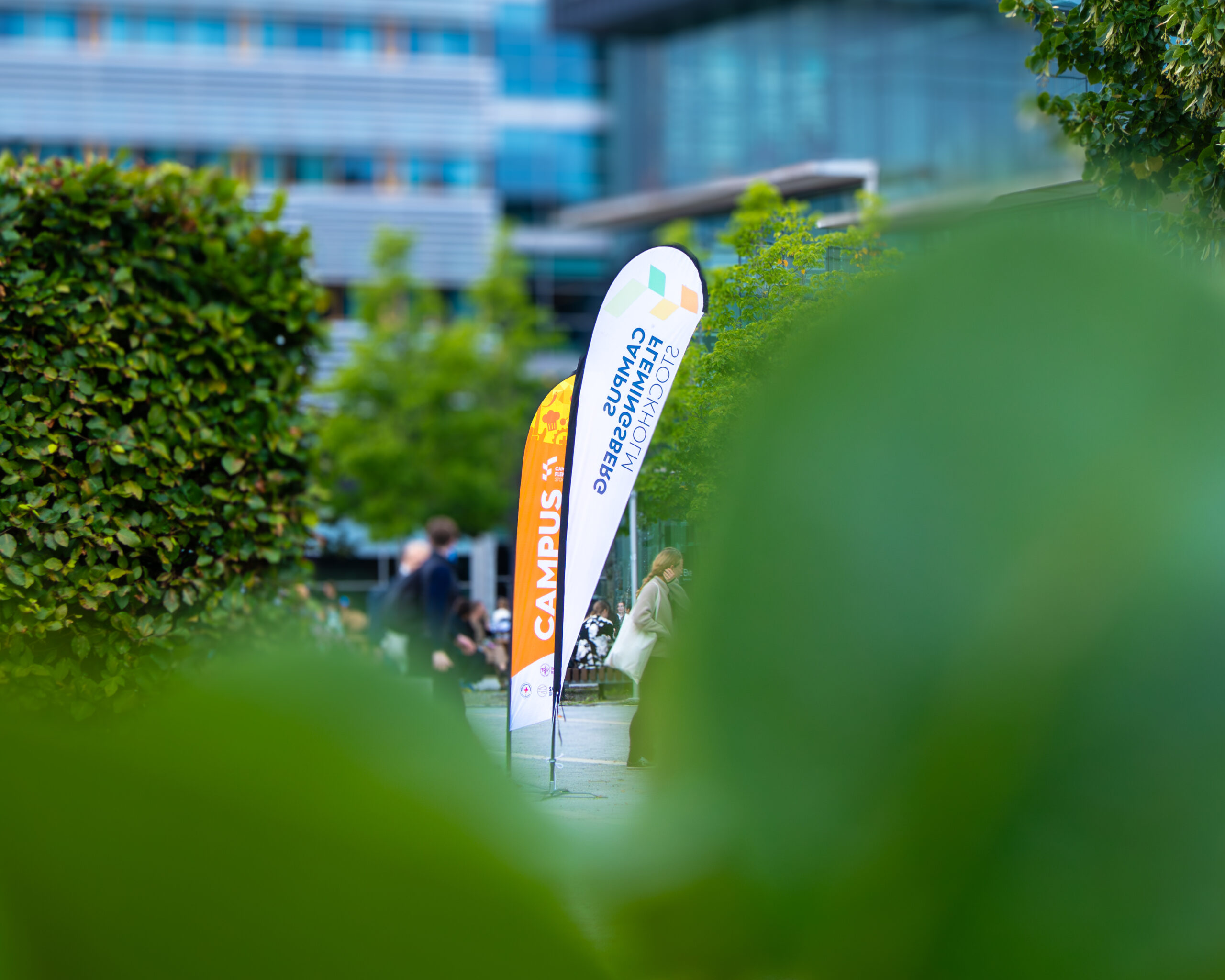
Campus Day 2025: A Hit of Music, Culture, and Community
FLEMINGSBERG – Campus Day 2025 in Flemingsberg was a huge success. The event, which was organized to welcome new students and reunite old ones, offered a versatile palette of activities and impressions. Students from Karolinska Institutet, KTH, Röda Korsets högskola, Stockholms musikpedagogiska institut (SMI), and Södertörns högskola participated in the celebration.
The event, held at the start of the new term, gave students a unique opportunity to meet student unions and other support functions, and take part in fun activities and competitions.
Anna Paulson, a student from SMI, expressed her joy about the diversity on campus:
“Community doesn’t just come from one program, but from all programs at the same place coming together and meeting each other.”

Foto: Eva Gauffin
Entertainment and Networking
This year’s Campus Day offered a powerful experience with students from SMI providing a cavalcade of entertainment. From art-pop and Japanese folk music to spoken word and a classical duet, the stages were filled with impressive talent.
The university presidents from the different institutions were on-site to give valuable tips to the new students. Student unions also play an important role in helping students feel welcome, and the SöderS student union brought their operations to Campus Day to promote a better student life.
“It was great to see so many students from the different universities on Campus Flemingsberg dare to come up and ask questions about our activities, our associations, and about student life at Södertörns högskola!” — SöderS
An Important Platform for the Future
A popular part of the event was the group quiz competition, which was followed by well-deserved burritos from Allé Elva. Between activities, there was plenty of time for students to talk and network with relevant groups on campus.
Helene Komlos Grill, Communications Manager at Röda Korsets Högskola, describes Campus Day as an important platform for collaboration.
“Campus Flemingsberg is a great campus area with about 24,000 students and many exciting study programs and research fields. Campus Day is a happy and fun day where we get to meet students and staff from all the universities on campus,” she says.
The event has not only become a cherished tradition but also an important platform for building networks and community in Flemingsberg. For the organizers, it is important that the event continues to grow and engage more people.

Foto: Oskar M Wiik (SMI)
Omslagsbild av: Oskar M Wiik (SMI)
From Science Week: Innovative arenas create collaboration for the city of the future
See the panel discussion on how innovative neutral arenas are central to the development of the smart and knowledge-intensive city. Flemingsberg Science CEO Johnny Högberg participates together with a panel consisting of Sophia Sundberg, CEO, Barkaby Science, Peter Dobers, Professor of Business Administration with a focus on sustainable development and collaboration, Södertörn University, Johan Zachrisson, Business Development Manager, Fabege and Anton Västberg, Development Director, Region Stockholm.
Test your business idea: Flemingsberg Science Award Startup open for applications
STARTUP is a competition for startups with a clear connection to Flemingsberg, either as students, residents or otherwise active in the area. All ideas are welcome to participate in STARTUP as long as you compete with your own idea and the turnover and external equity is below SEK 1,000,000 at the time you submit to the competition. After that, we of course welcome you to continue working with the business idea, sales and any investments.
Science Week: Innovative arenas create collaboration for the city of the future
Stockholm is growing and we want a smart city with knowledge-intensive industry that is sustainable. In a panel discussion during Science Week on February 1, we discuss how innovative neutral arenas are central to the development of the smart and knowledge-intensive city.
Our Sound Space – soundscapes in cities
Don’t miss the opportunity to experience an interactive sound installation at the same time as you contribute to research that improves the future of urban planning.
The Our Sound Space installation has now opened at Neo in Flemingsberg, which offers visitors the opportunity to use their smartphones to experiment with different sound environments and explore with soundscapes.
Our Sound Space is part of the Planning for Youth research project that aims to study methods and tools for meaningful participation of the younger demographic groups in participatory planning and placemaking. Romina Rodela is Docent at Södertörn University and project leader for the initiative. ““Historically, children and young people have not been very central in spatial planning. In our project, we want to explore new methods which are better able to capture their voice in spatial planning and placemaking,” says Rodela.
In this case, you use your smartphone to listen to how a new residential area will sound, for example. Which sounds are perceived as positive and which sound environments are less attractive? The idea is to give the planners of the future better tools to include children, young people and people with impaired vision or other functional variations in the planning stages of such projects. “We’ll use Our Sound Space to gather opinions from different groups to establish how effective a tool like this can be. At the same time, the installation is open to all to try out and comment on,” says Rodela. The software itself is developed by researcher Maurizio Goina at KTH and may in future be shared with planners, construction companies and architects.
Mattias Lindén is responsible for Hemsö’s properties in Flemingsberg and believes that installations such as Our Sound Space have the potential to improve the image of the area. “We’re sitting on an underused resource. In courtyards and along walkways there are areas that could be used for temporary art exhibitions – opportunities for as yet undiscovered artists to gain some exposure. We’ve just decided to support the Our Sound Space project. Imagine if people in the future will associate Flemingsberg with exuberant creativity, a place where you experience new and fresh ideas. Our Sound Space can be a small step in that direction,” says Lindén, Senior Property Manager at Hemsö. Our Sound Space runs until 7th March, while the research project will continue for another two years.

